An AI agent can answer a question in seconds. But can it recognize that your customer has an unresolved support issue, recently renewed a contract, and is already speaking with your sales team?
That context determines whether the next interaction is useful, or creates more work.
For companies working toward becoming an agentic enterprise, where people and AI agents collaborate across business processes, the quality and accessibility of business data deserve as much attention as the agents themselves.
Salesforce Data 360 helps build that foundation.
From disconnected records to shared context
Customer information often lives across Salesforce, marketing platforms, billing systems, support tools, and documents. Each system holds part of the relationship.
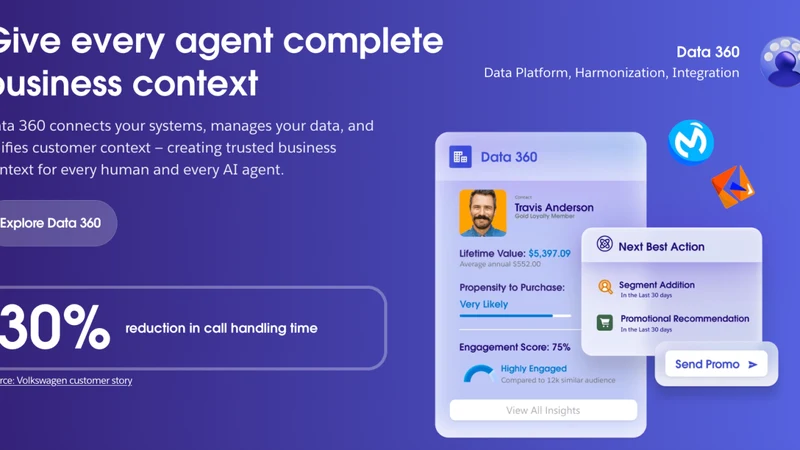
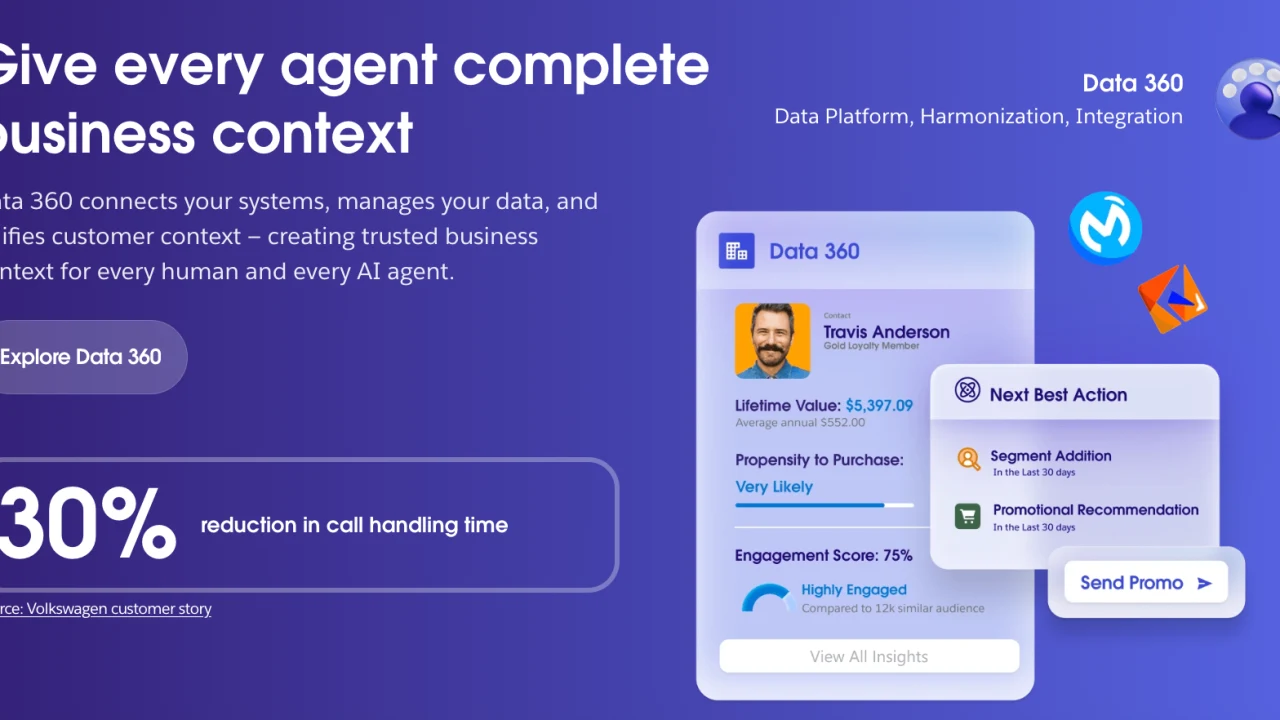
Data 360 helps connect and harmonize that information, resolve customer identities across sources, and make unified data available for business applications and Agentforce. It also supports structured and unstructured data, helping agents retrieve relevant business knowledge alongside customer records.
For a growing company, this creates an opportunity to give teams and agents a more consistent understanding of the customers they serve.
What could this look like in practice?
Consider a customer asking about an upcoming renewal.
In a well-designed implementation, an agent could use relevant contract information, recent interactions, and approved policies to assist with the request. Defined actions could allow it to initiate a follow-up task, while questions requiring judgment could be routed to a person.
Salesforce’s Agentforce architecture supports this combination of contextual information, defined actions, guardrails, and human escalation. The resulting experience depends on how those components are configured for the business.
Readiness starts with business decisions
Before expanding agent capabilities, leadership teams should be able to answer:
- Which process are we improving? Start with a specific problem and a measurable outcome.
- Which information should the agent trust? Identify authoritative sources and address conflicting or incomplete records.
- What is the agent allowed to do? Define access, actions, approvals, and escalation points.
- How will we evaluate performance? Track accuracy, successful task completion, exceptions, and customer experience.
Data 360 provides capabilities for unification and governance. Turning those capabilities into dependable operations requires clear ownership, thoughtful process design, and ongoing validation.
Where Palm Consulting comes in
Palm Consulting is a Salesforce Consulting Partner helping businesses and nonprofits align Salesforce with their business goals.
We help organizations assess their current processes, data quality, integrations, and access model, then define a practical roadmap for Data 360 and Agentforce based on their needs.
Our approach starts with the business: what your team needs to accomplish, where information breaks down, and which responsibilities make sense to delegate to an agent.
For organizations exploring this transition, a useful first step is choosing one process, identifying the context it requires, and establishing how success will be measured.
Is your business data ready to support the responsibilities you want to give AI?